“If you’re trying to teach leadership by explaining it, you might be doing it wrong.”
The Impact of Storytelling on Youth Learning
Let’s talk about using stories to communicate with youth. It is very important to consider how they think and process information. As adult leaders, we can sit through lectures and analyze the different facets and complexities within them. However, youth and scouts, especially the younger ones, do not engage in this way. When you share a story, it is much easier for them to absorb information and truly understand what leadership means. Stories allow scouts to visualize leadership in action, making the concept much more tangible and meaningful.
Stories vs. Lectures: Creating Lasting Memories
Scouts often do not remember lectures or the things we tell them unless those lessons are connected to a moment or a story. This is a key point when communicating with youth. The story should include elements that help scouts connect the dots, enabling them to grasp the essence of leadership. A well-told story creates an emotional bond, which is instrumental in shaping and forming the character we aim to develop. If you convey leadership through a story, scouts will learn it faster and more effectively than through any other form of communication.
Constructing Effective Mentoring Stories
What makes a good mentoring story? Every story has three specific parts: a beginning, a middle, and an end. These components each serve a distinct purpose. At the beginning, clarify the situation and describe the characters, their behavior, and the actions they have taken. The scenario should be clear and relatable. In the middle, present the struggle or challenge that must be overcome, this could be as simple as getting water to a fire. The hero’s journey is a central theme, and it is vital that scouts can relate to the character facing the challenge. At the end, offer a relatable lesson, a conclusion, and a resolution that aligns with the Scout Oath and Scout Law. This structure is key to an effective mentoring story.
Applying Stories in Mentoring Scouts
If you are teaching and mentoring scouts, it is essential to ensure the lesson is clear. These are the main aspects to consider when using a story or analogy. This storytelling approach should be used frequently with youth. For example, if a scout is experiencing a problem within a patrol, such as new scouts, older scouts, and scouts from different schools, where no one wants to be Patrol Leader, you can tell a story that mirrors the situation. When everyone tries to be the boss, chaos ensues: campsites become disorganized, menus are forgotten, dishes go uncleaned, and nothing is coordinated. In this scenario, too many chiefs and no Indians lead to disorder.
Lessons Learned Through Stories
The lesson learned from such stories is that success requires a leader. Leadership can rotate among members, but it is crucial to have someone guiding the group, making decisions like where to set up tents and when to eat lunch. When the scouts understand this, they succeed. That is the story, the analogy, and the lesson. Use these stories often when mentoring to help youth internalize leadership concepts.
Maximizing the Effect of Storytelling
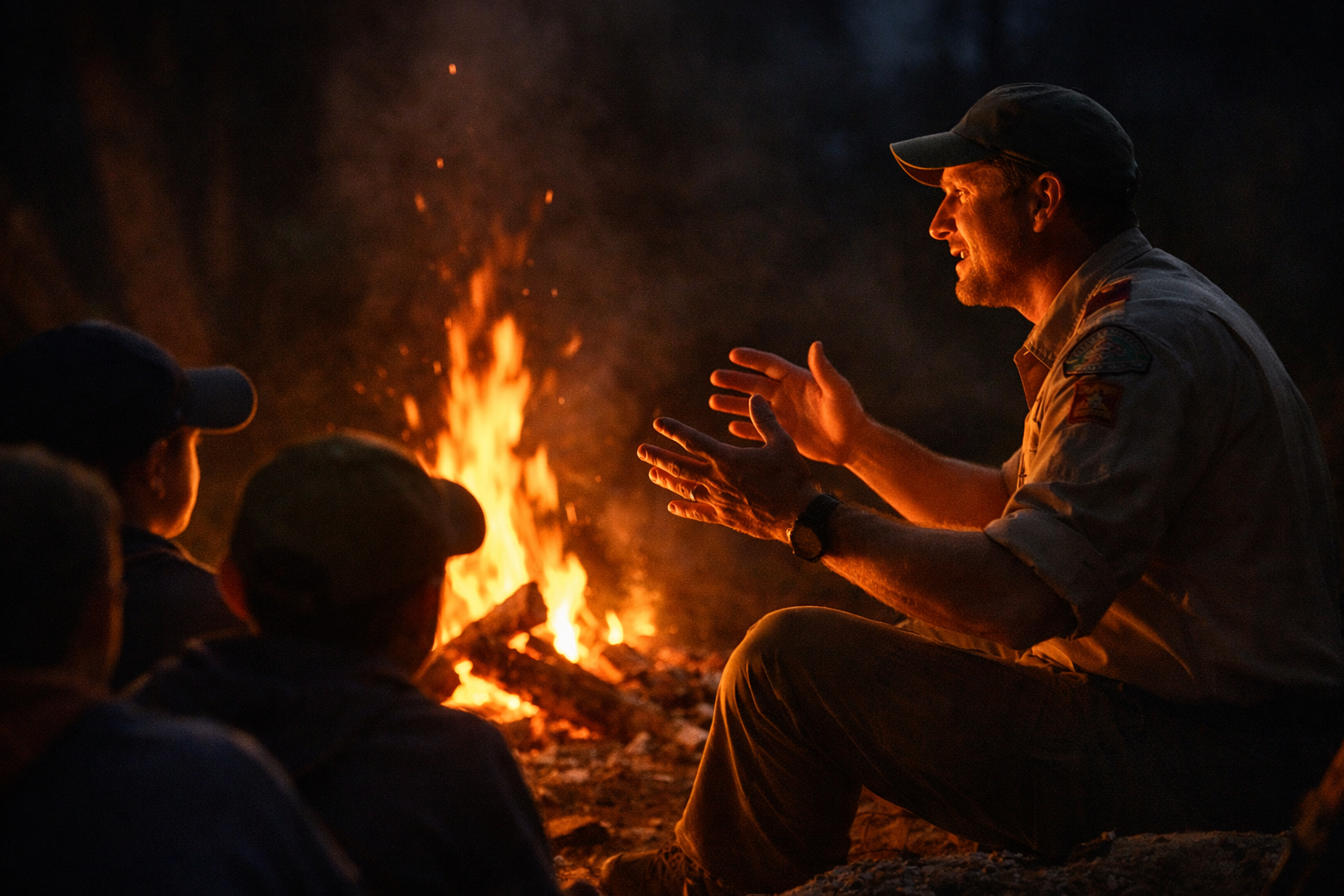
Knowing when to use storytelling is critical. It is important not to spend too much time telling stories; with youth, the message must be delivered quickly. There are many stories available online, so find one that works for your unit. To maximize impact, choose the right moment, such as around the campfire. Campfires tend to start slow, peak, and then fade, so the best time for stories is at either end. The Scoutmaster can use this time for a Scoutmaster’s Minute, sharing stories about leadership and challenges. The “beginning, middle, end” structure fits well and allows scouts to reflect on the meaning. Many people hear words without understanding the meaning, so the skill lies in effective communication through storytelling.
Other Opportunities for Storytelling
Another approach is after a failure or notable event, where a scout leader gathers scouts and tells a factual story or analogy. This helps young people relate and understand current events, especially when the story connects to the Scout Oath and Scout Law. Whenever possible, present things in a positive light, reinforcing the values scouts are expected to uphold.
The Scoutmaster’s Minute and Guest Storytellers
The Scoutmaster’s Minute is typically a 60-second story or analogy designed to capture the attention of young scouts. It does not always have to be delivered by the Scoutmaster; guests, Assistant Scoutmasters, committee members, parents, or even someone reading from a script can share these stories. There are thousands available online, so mix it up for variety and greater impact.
Choosing the Right Time for Storytelling
Storytelling should not be used during chaotic moments or when facing immediate challenges. Safety comes first, and it is best to handle issues before gathering everyone for a story. Use common sense, most adults can determine when it is appropriate. Storytelling is most effective for group learning and lessons, rather than individual situations.
Mentoring Versus Lecturing
Mentoring differs from lecturing. In a lecture, you do not see your audience; you see a computer screen. When mentoring, you see the scouts, observe their expressions, and gauge their attention. Storytelling and analogies foster relationships, provide feedback, and encourage engagement. Lecturing can be monotone and disconnected from young people, while stories about scouts facing challenges and succeeding bring focus and meaning. One-on-one storytelling is especially powerful, helping scouts get more from mentoring. Use analogies and stories that they can comprehend and relate to, rather than falling into lecture mode.
Empowering Youth Through Storytelling
It is powerful to have scouts tell their own stories. Den Chiefs and Guides can encourage scouts to share experiences of overcoming challenges and succeeding. Stories from youth resonate more than those from adults, allowing peers to relate and absorb lessons instantly. Challenge youth to share stories about being friendly, courteous, and kind, and let them tell their stories for greater impact.
Common Mistakes to Avoid
A major mistake is telling stories that go on too long or lack a clear flow. Stories should have a straightforward beginning, middle, and end, and be concise. Avoid making yourself the hero, as it can upset others. Use ambiguous characters and relatable scenarios, not stories focused on people in your immediate circle. Do not turn stories into lectures. Stories should allow recipients to reflect and internalize the lesson, without being preachy. Always use stories at the right time and avoid lengthy, drawn-out narratives. If scouts are uninterested, stop and wait for their engagement.
A Challenge for Mentors
Here is a challenge: the next time you discuss leadership or interact with youth, step back and use a story or analogy that they can relate to. This will improve communication and mentoring effectiveness. Remember, mentoring involves engaging with scouts, helping them find solutions on their own, and making concepts meaningful through storytelling.
Encouraging Story Sharing and Continuous Learning
If you have a short story, less than two paragraphs, about the Scout Law, consider sharing it in the comments. Stories shared by youth or about the values in scouting are inspiring and help others learn. There are many resources and videos about storytelling, including booklets at the scout shop. Keep up the hard work, respect others, and continue learning. Check out resources for Scoutmasters and Senior Patrol Leaders to address common challenges, such as understanding leadership roles, and I will see you on the trail. YIS⚜
🌐 Why succession planning is a must in every Scouting unit: https://blog.scoutingmagazine.org/2017/01/06/next-up-why-succession-planning-is-a-must-in-every-scouting-unit/🌐 All Cub Den Leaders: http://www.scouting.org/programs/cubscouts/den-meeting-resources/
🌐 Cubmaster Resources: http://www.scouting.org/programs/cubscouts/pack-meeting-resources/
🌐 Pack Committee Resources: http://www.scouting.org/programs/cubscouts/pack-committee-resources/
🌐 Scoutmaster Minutes https://www.boyscouttrail.com/boy-scouts/boy-scout-minutes.asp
📄 The Scoutmaster’s Minute PDF https://filestore.scouting.org/filestore/pdf/SMMinute.pdf
🎬 Scout Leaders minute, moment, or epiphany? (2019) https://youtu.be/4LH9AjXlM-8
🎬 Unlock the Secret to a Successful Leadership Transition https://youtu.be/XVxIS-HbGCY – OR – https://youtu.be/SHZATl0t5wQ
🎬 What Most Scoutmasters Get Wrong! https://youtu.be/zwK88pUOUtA – OR – https://youtu.be/9V3Vjl6QYR0: Storytelling as a Powerful Tool for Teaching Leadership to Youth
