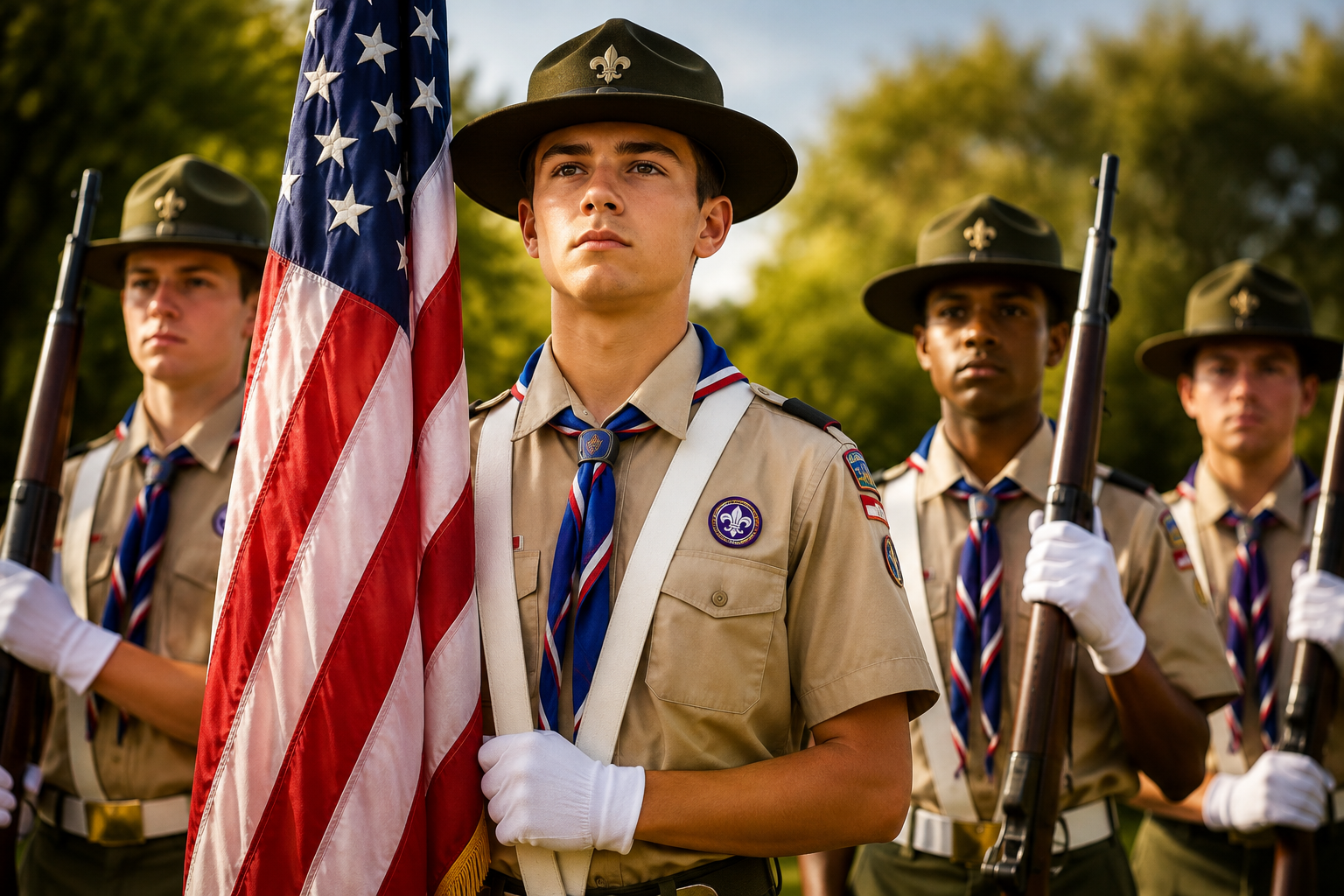
A Scouting America youth Honor Guard is a specially prepared group of older Scouts who represent Scouting at formal flag ceremonies, civic events, memorials, parades, and other public gatherings. While many packs or troops assign Scouts to present the colors at regular meetings, an Honor Guard is typically more organized, more selective, and trained for higher-profile ceremonies where precision, respect, and appearance matter.
What an Honor Guard Does
The primary duty of a youth Honor Guard is to present, carry, and retire the colors with dignity. Depending on the event, the colors may include the American flag, a state flag, unit flags, or other flags appropriate to the ceremony. These ceremonies may take place at public meetings, council or district events, memorial services, commemorations, parades, and community celebrations.
An Honor Guard may be organized through a council, district, or local Scouting group. Some groups use their own leadership titles, such as brigade captain, and may have distinctive patches, uniforms, or equipment. Because each council operates differently, Scouts and leaders should contact their local council service center to learn whether an Honor Guard already exists and how it is organized.
What a Typical Assignment Looks Like
Honor Guard assignments usually begin well before the day of the event. The team must understand the ceremony, inspect uniforms, prepare equipment, and rehearse the specific movements required. Some events may require different uniform pieces, especially for outdoor ceremonies or weather conditions, so expectations should be confirmed in advance.
- Before the event, the team confirms instructions, inspects uniforms, reviews the ceremony, and practices the planned movements.
- On the day of the event, members arrive early, complete a walk-through, and adjust to any last-minute changes in entrances, exits, timing, or staging.
- After the event, the team secures and cleans equipment, stores flags and flag-carrying gear properly, and completes an after-action review to identify what went well and what can be improved.
Skills Honor Guard Members Need
An Honor Guard depends on preparation, discipline, and teamwork. Youth members carry out the ceremony, while adult leaders usually coach, mentor, coordinate with event organizers, and support the team from behind the scenes.
- Attention to detail: Members must understand the assignment, wear the correct uniform, place patches properly, and prepare ceremonial equipment.
- Reliability: Honor Guard members must attend practices, arrive early, and be ready when the team is called to serve.
- Confidence and composure: Ceremonies often happen in front of large crowds, cameras, or important guests, so members must stay focused and calm.
- Discipline: Members must stand still, follow commands, maintain formation, and execute movements precisely.
- Teamwork and command presence: The team must move together, respond to commands, and communicate clearly when giving or receiving instructions.
- Adaptability: When something changes, or a command is unclear, members must recover smoothly and continue the ceremony respectfully.
What Makes Honor Guard Service Challenging
Serving on an Honor Guard can be demanding. Members often arrive very early, sometimes hours before the ceremony begins. In Scouting, as in the military, the saying applies: “Early is on time, on time is late, and late is not acceptable.”
Many ceremonies also require Scouts to stand at attention for long periods, perform memorized procedures, and remain steady under pressure. Weather can add another challenge, especially for outdoor ceremonies in places like Central Florida, where rain and storms are common. A prepared Honor Guard plans for those conditions and practices enough to stay synchronized even when the setting changes.
Why an Honor Guard Matters
An Honor Guard gives older Scouts a meaningful role where they can build confidence, practice leadership, and visibly represent Scouting America. It also strengthens the traditions and ceremonies that are part of Scouting culture, including respect for the flag, the Scout Oath, and the Scout Law.
For many Scouts, Honor Guard service becomes a source of pride. It teaches flag etiquette, ceremonial discipline, teamwork, public speaking, and reverence for national and community traditions. It also creates friendships and community connections that can last well beyond a single event.
How to Get Involved
Start by asking your unit leadership whether your council or district already has an Honor Guard. Your council service center can usually tell you whether a team exists, who coordinates it, and what the joining requirements are. Requirements may include an age range, rank level, application process, tryout, uniform standards, and a commitment to training and practice.
If no Honor Guard currently exists, interested leaders may be able to help organize one in cooperation with the council or district. Because practices, assignments, and expectations vary widely, the best first step is to ask locally and gather accurate information before making plans.
What Scouts Gain from Honor Guard Service
Honor Guard service builds confidence because Scouts learn to perform with precision in front of others. It strengthens leadership by giving youth real responsibility in ceremonies that matter to the community. It also teaches practical skills, including flag folding, flag presentation, flag retirement, public speaking, and respectful ceremonial conduct.
Most importantly, an Honor Guard gives Scouts another meaningful way to serve. It helps older Scouts stay engaged, provides a visible example of Scouting’s values, and offers a disciplined way to honor the community, the flag, and the best traditions of our movement. Until next time, I’ll see you on the trail.
