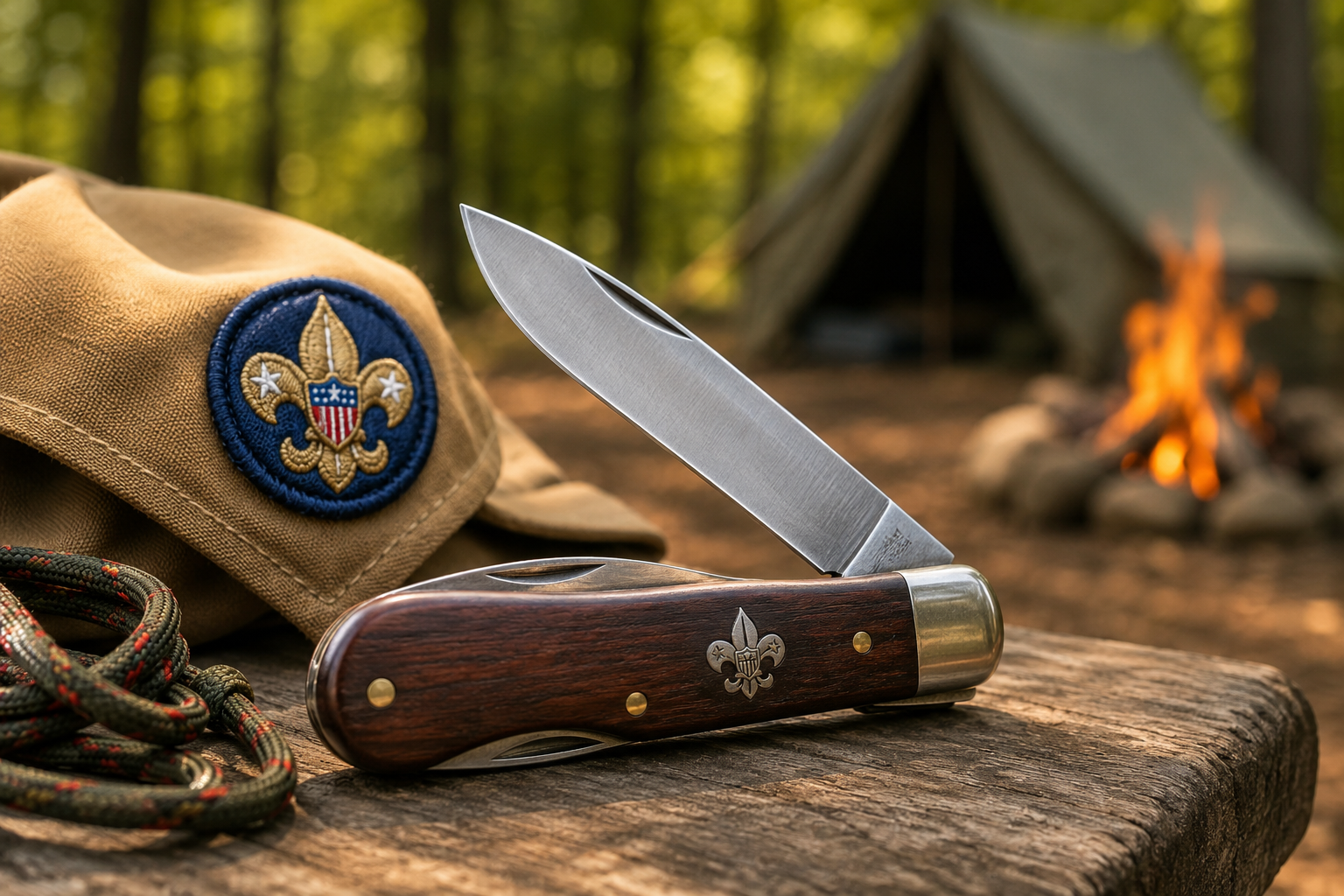
A pocket knife is one of the most useful tools a Scout can carry, but it is also a sharp object that can cause serious injury. Why, then, does Scouting America permit Scouts to use one? The answer lies in training, appropriate use, and personal responsibility.
A Tool, Not a Toy
In Scouting, a pocket knife is treated as an essential tool, not an entitlement or a plaything. Scouts may use knives and other cutting tools for specific outdoor tasks, such as cutting cord, preparing kindling, or completing a project. A knife should be carried only when it serves a clear purpose.
That distinction also determines where a knife belongs. Pocket knives should not be taken to schools, airports, or other places where they are prohibited, unnecessary, or could endanger the public. Before carrying one, a Scout should ask: What job will this tool help me do?
Training and the Totin’ Chip
Scouting does not simply hand a young person a knife and hope for the best. Scouts receive instruction before they are permitted to use one. The Totin’ Chip represents more than permission to carry a knife; it confirms that a Scout has learned the responsibility that comes with using cutting tools.
Current requirements can change, so leaders and families should verify them through official Scouting America resources. If a Scout misuses a knife, leaders may temporarily remove both the knife and the Totin’ Chip privilege. The Scout can then repeat the training and demonstrate safe behavior before regaining that privilege.
Core Knife-Safety Practices
Scouts should consistently follow these basic practices:
- Create a safe working area. Keep other people outside the knife’s safety zone, sometimes called a “blood circle.”
- Cut away from the body. Maintain control of the blade and direct each cut away from yourself and others.
- Keep the knife clean and sharp. A dull blade requires more force and is more likely to slip.
- Stop when the area becomes unsafe. If someone runs, crowds the user, or enters the safety zone, close or sheath the knife immediately.
- Stay aware. Everyone nearby should recognize that a cutting tool is in use and give the user adequate space.
Adult leaders must observe Scouts as they use knives and intervene immediately when a safety rule is ignored. Asking a Scout to close or sheath the knife is not an overreaction; it is a leader’s responsibility.
Introducing Knives in Cub Scouting
Knife instruction for Cub Scouts should be matched to age, maturity, unit policy, and the activity. Younger Cub Scouts, especially Lions and Tigers, are generally not ready to carry pocket knives. Older Cub Scouts, such as Webelos and Arrow of Light Scouts, may be ready for supervised instruction if their unit permits it.
Some Cub Scout activities teach age-appropriate cutting skills, including supervised food preparation with kitchen knives. These lessons can build coordination and respect for sharp tools without making a pocket knife part of every activity. In most Cub Scout settings, if a knife is not needed, it should stay at home.
Age Matters Less Than Observable Maturity
There is no single age that answers when a Scout is ready for a pocket knife. Readiness depends on observable maturity. Parents and leaders should consider whether the Scout:
- Understands that a knife is a tool rather than a toy.
- Follows instructions without repeated reminders.
- Uses the knife only for an appropriate task.
- Maintains a safe working area.
- Accepts correction and responsibility.
If a Scout treats the knife as a status symbol, uses it carelessly, or ignores safety guidelines, that Scout is not ready to carry it, regardless of age. The same principle applies to adults: a knife should be carried only when it is needed for a legitimate task.
Choose the Right Tool for the Job
The best knife depends on the work to be done. A Scout might need a folding knife to cut cord at camp, while food preparation calls for an appropriate kitchen knife. Leaders should help Scouts think ahead and select the safest tool that can perform the task.
Before bringing a knife, ask:
- What specific task requires it?
- Is this type of knife suitable for that task?
- Does the Scout have the training and maturity to use it safely?
- Will the tool be permitted at the meeting, event, camp, or destination?
Being prepared does not mean carrying every possible tool. It means anticipating the task and bringing the correct equipment when it is genuinely useful.
Fixed Blades and Local Rules
Scouting America’s safety guidance may not expressly prohibit every fixed-blade knife, but that does not mean every knife is appropriate everywhere. State and local laws, council policies, camp rules, and event requirements may impose additional restrictions.
Leaders and Scouts should verify the rules before an activity and consider whether the knife has a practical purpose. Legality, policy, suitability, and maturity all matter when deciding whether a particular blade should be brought.
The Larger Lesson: Responsibility
The central lesson of knife safety is responsibility. A pocket knife can be a valuable tool, but it can quickly become dangerous when it is handled carelessly. Scouts must learn to respect the blade, the people around them, and the privilege of carrying it.
When a Scout uses a knife unsafely, a leader should act promptly:
- Ask the Scout to close or sheath the knife.
- Take control of the knife if necessary.
- Temporarily suspend the Scout’s knife-carrying privilege.
- Discuss the incident with the appropriate unit leader and the Scout’s parent or guardian.
- Provide retraining and require the Scout to demonstrate safe behavior before restoring the privilege.
The goal is not to punish a Scout for making a mistake or to keep young people away from useful tools forever. The goal is to teach judgment, safe habits, and accountability. Minor injuries can happen even with training, but careful instruction and supervision reduce the risk and help Scouts develop lifelong skills.
The Leader’s Role
Knife safety extends beyond completing the Totin’ Chip. Leaders must continue to coach, observe, and correct Scouts whenever cutting tools are used. Young people need clear expectations, consistent supervision, and adults who are willing to intervene when safety is at risk.
Whether the tool is a pocket knife, a fixed blade, a saw, or an axe, the principle is the same: use the right tool for a legitimate purpose, follow applicable rules, and handle it with care. Teaching that responsibility is one more way Scouting helps young people grow into capable and thoughtful adults.
Thank you for the time, leadership, and care you give to Scouting. Your guidance helps build safer, more responsible Scouts, one experience at a time. Until next time, I hope to safely see you on the trail.